toda noticia "stone", la encontras aqui ....! "every stone news, you find it here"


* toda noticia "stone", la encontras aqui ! : informaciòn de los miembros de la banda, sus mùsicos, sus esposas , sus ex esposas , parientes e hijos ...

* "every stone news, you find it here: information of its members, its musicans and their wives, ex wives, partners and children ...."

* Los Stones son más que una banda de rock , los Stones son un estilo de vida!

* The Stones are more than a rock band, the Stones are of life style !
ANDREW LOOG OLDHAM

* Las publicaciones son trabajos de investigación, interpretación y traducción del autor ( Marcelo Tejera ) y no pueden ser reproducidos en otros sitios web, en todo o en parte, sin su autorización expresa.

* publication are research. interpretation and translation of the author (Marcelo Tejera) and may not be reproduced on other websites, in whole or in part, without express authorization.


miércoles, 8 de febrero de 2017

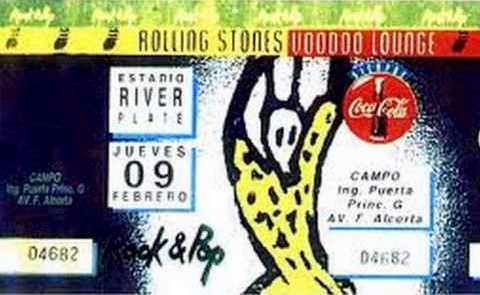
Hace 22 años: The Rolling Stones llenaron de "Satisfacciòn" al Estadio River Plate , por primera vez... (Relato de aquella noche magica)


Despues de 33 años , esperando su llegada , tres generaciones de Argentinos, deliraron con un show espectacular 


El estadio de River Plate,  quedò completamente a oscuras,  a las 21.33 hs . Acto seguido, la gigantesca torre , con forma de cobra, que coronaba el gigantesco escenario,  comenzò a iluminarse y , tras unos potentes haces de luces rojas y verdes , que apuntaban al pùblico, aparecieron , envueltos en una ovaciòn que demorò 33 años en estallar, los Rolling Stones.


Fuè el delirio, la voz de Mick Jagger (remera y saco rojo, chaleco y pantalones negros, sensualidad intacta a sus 51 años) arrancò "Note Fade Away" , mientras Keith Richards, desgranaba su legendaria guitarra, contoneando su cuerpo con un cigarrillo en la boca. Detràs de ellos, Ron Wood y Charlie Watts, apoyaban con sus respectivas guitarra y bateria, el primer tema de la banda de rock, màs grande del planeta. Era lo que , los màs de 60.000 espectadores , que se comprimìan en el estadio, esperaban ver y escuchar y , sin embargo, llegado el momento , no terminaban de creer.  El campo era una alfombra compacta y ondulante, que se sacudìa con la musica Stone , esa banda de sonido , de la pelìcula de tres generaciones: abuelos, padres e hijos,  latiendo al mismo pulso.


Luego de la segunda canciòn (Tumblin' Dice) , Jagger dijo en español: "Bienvenidos al Voodoo Louge Tour" , en referencia al ùltimo disco y nombre de la gira. Las gargantas respondieron, con un saludo interminable.
Siguieron "You Got Me Rockin`" , "It`s All Over Now", Undercover (in the Night) , un tema dedicado a los desaparecidos de Amèrica Latina, que fuè precedido por un pàrrafo,  en español de Jagger, que resultò algo confuso:  "Esperamos tres años, gracias por venir" . A 35 minutos de comenzado el show, el primer golpe al corazòn: "(I Can't Get No) Satisfaction " un terremoto que se desparramò, sobre el barrio de Nuñez, coreado por la multitud.


A continuaciòn la balada Out of Tears , provocò el encendido,  de decenas de miles de encendedores. Charlie Watts, en tanto, seguìa machacando sobre la baterìa , desde una tarima mòvil, que avanzaba o retrocedìa , de acuerdo al tema. Watts estaba encerrado , entre dos paneles acùsticos de vidrio. En uno de ellos, el baterista , tenìa pegado un papel con el setlist, dejando clara su misiòn , de marcar el pulso rìtmico de la banda , apoyado por Darryl Jones, reemplazante de Bill Wyman, quièn dejo la banda en 1992.
Los encendedores se apagaron, pero por solo algunos segundos. Porque enseguida se escucharon los primeros acordes de "Angie" , ese clàsico inoxidable,  que convirtiò al estadio en un coro gigantesco, desafinado y emotivo.


 A las 22.45 hs, cuando el show promediaba, Mick Jagger presentò a cada uno de los miembros de la banda, incluyendo los mùsicos de apoyo: Chuck Leavell en teclados, Bobby Keys en saxo , Lisa Fischer , Bernard Fowler , Blondie Chaplin ... A su vez, Ronnie Wood fuè el encargado de presentar al cantante, quien , junto a Keith Richards , se llevò la ovaciòn màs larga de la noche.


Pero el pico de emociòn llegò con "Brown Sugar", cuyo final, el tìpico canto: "yeah, yeah, yeah, hu!" fuè coreado por todo el estadio y dirigido por Mick Jagger. Sin respiro arrancò el demoledor "Jumpin Jack Flash" , en el que Jagger, se sacò la remera y comenzò a revolearla sobre su cabeza, mientras todo el pùblico lo imitaba, generando un mar de hèlices. Entonces se abrieron a los costados del escenario , como aguas danzantes, fuegos artificiales plateados . El ùltimo acorde y el saludo de todos los mùsicos, para dar paso a los cuatro legendarios Stones, que abrazados se despidieron de la multitud. No hubo bisces, pero sì un cielo , que amaneciò magneticamente , por los efectos de la tremenda pirotecnia.
Asì se fuè extinguiendo el fuego,  de la primera de las cinco noches que hicieron arder a Buenos Aires, con la leyenda de los Rolling Stones.


22 years ago: The Rolling Stones filled River Plate Stadium with "Satisfaction" for the first time ... (Story of that magic night)


After 33 years, waiting for his arrival, three generations of Argentines, delirious with a spectacular show

The stadium of River Plate, was completely dark, at 21.33 hs. Then the gigantic cobra-shaped tower, which crowned the gigantic stage, began to illuminate, and after powerful bundles of red and green lights aimed at the public, they appeared, wrapped in an ovation that took 33 years to explode , The Rolling Stones.

It was delirium, the voice of Mick Jagger (red shirt and jacket, waistcoat and black trousers, intact sensuality at age 51) ripped "Note Fade Away" while Keith Richards flaunted his legendary guitar, wiggling his body with a cigarette in mouth. Behind them, Ron Wood and Charlie Watts, supported with their respective guitar and drums, the first theme of the rock band, the biggest on the planet. It was what, more than 60,000 spectators, who were compressed in the stadium, hoped to see and hear and yet, when the time came, they did not believe. The field was a compact and undulating carpet, which rocked with the music Stone, that soundtrack, of the film of three generations: grandparents, parents and children, beating at the same pulse.

After the second song (Tumblin 'Dice), Jagger said in Spanish: "Welcome to the Voodoo Louge Tour", referring to the last album and name of the tour. The throats responded, with an endless greeting.They followed "You Got Me Rockin", "It`s All Over Now", Undercover (in the Night), a subject dedicated to the disappeared ones of Latin America, that was preceded by a paragraph, in Spanish of Jagger, that resulted somewhat Confused: "We wait three years, thanks for coming." 35 minutes after the show began, the first blow to the heart: "(I Can not Get No Satisfaction)" an earthquake that spilled over the neighborhood of Nuñez, chanted by the crowd.

Then the ballad Out of Tears, caused the ignition, tens of thousands of lighters. Charlie Watts, meanwhile, was still pounding on the battery, from a moving platform, moving forward or backward, according to the theme. Watts was enclosed between two glass panels. In one of them, the drummer, had a piece of paper with the setlist, making clear his mission, to mark the band's rhythmic pulse, supported by Darryl Jones, replacement of Bill Wyman, who left the band in 1992.The lighters went off, but for only a few seconds. Because immediately the first chords of "Angie", that classic stainless, was heard that turned the stadium into a gigantic, out of tune and emotional choir.


At 10:45 a.m., when the show averaged, Mick Jagger introduced each member of the band, including supporting musicians: Chuck Leavell on keyboards, Bobby Keys on sax, Lisa Fischer, Bernard Fowler, Blondie Chaplin ... In turn, Ronnie Wood was in charge of presenting the singer, who, along with Keith Richards, took the longest ovation of the night.

But the peak of excitement came with "Brown Sugar", whose ending, the typical song: "yeah, yeah, yeah, hu!" Was chanted throughout the stadium and led by Mick Jagger. Without a breath he ripped off the jolting "Jumpin 'Jack Flash," in which Jagger pulled his shirt and began to roll it over his head, while the whole public imitated him, generating a sea of ​​helices. Then they opened to the sides of the stage, like dancing waters, silvery fireworks. The last chord and the greeting of all the musicians, to give way to the four legendary Stones, who hugged each other farewell to the crowd. There were no bisces, but a heaven, which dawned magnetically, by the effects of the tremendous pyrotechnics.Thus the fire was extinguished, the first of the five nights that burned Buenos Aires, with the legend of the Rolling Stones.


* Las publicaciones son trabajos de investigación, interpretación y traducción del autor ( Marcelo Tejera ) conjuntamente con sus fotos y no pueden ser reproducidos en otros sitios web, en todo o en parte, sin su autorización expresa.

* Publications are research, interpretation and translation of the author (Marcelo Tejera) together with their photos may not be reproduced on other websites, in whole or in part, without your express permission.


viernes, 3 de febrero de 2017

Investigacion Stone. Que sucedió con la casa de Muddy Waters?


El sábado, 2 de febrero de 2013, "Stones Please Don´t Stop" publicaba este articulo :

Preservar la casa de Muddy Waters

Gracias al Chicago Tribune,  que llamó la atención sobre la difícil situación actual,  la casa Kenwood  de Muddy Waters (la "casa vacía Muddy Waters resultó ser" peligroso "en la inspección de la ciudad", Noticias del 25 de enero). Waters, uno de los más grandes maestros del blues, construyó los cimientos de su larga y resplandeciente  carrera en Chicago, el establecimiento de nuestra hermosa ciudad,  como el "hogar del blues".

Teniendo en cuenta la importancia cultural de 4339 S. Lake Park Ave., Una morada humilde pero vibrante, donde Waters  y numerosas leyendas del blues,  perfeccionaron su arte, el deseo de la ciudad para demoler la propiedad , viene como una sorpresa. La casa de Kenwood está en la necesidad obvia de restauración, demolición, pero francamente sería una deshonra,  a la memoria de Muddy Waters.

¿ Es la antigua casa de Muddy Waters un potencial museo , una atracción turística? ¿O debe ser derribado? Ese es el dilema reportado por Heather Gillers,  del Chicago Tribune.

Gillers proporciona detalles fascinantes de la vida del icónico músico de blues,  cuando era dueño de la casa, situada en el distrito  historico de North Kenwood.

Waters invitó a nuevos músicos a Chicago para vivir en el sótano, un espacio que había dividido , para dar cabida a varios invitados. Algunos se quedaron durante años. 

Hacían música. Un montón de música. Experimentaron, compusieron. Muddy dormía en una habitación por encima de la planta baja , para que pudiera escuchar y aprender la música que se estaba creando.

Esta es una razón , por la que algunos residentes de la Ciudad  , desean conservar la casa. Muddy es tan importante como Chicago mismo.

Espero que paren  las excavadoras. ¿Dónde estaría el cancionero fantasma y la memoria viva de Muddy?

LINK: 

http://stonespleasedontstop.blogspot.com.ar/2013/02/preservar-la-casa-de-muddy-waters.html

2 años despues del primer informe , el 27 de Febrero de 2015, Antonio Zavala escribía  para "Stones Please Don´t Stop" : 

 La casa donde la leyenda del blues Muddy Waters (1913-1983) , vivió durante dos décadas al sur de Chicago , luce hoy abandonada y la madera bloquea sus ventanas, pero si de algo están convencidos sus seguidores,  es de que vendrán mejores días y acabará convertida en museo.


A pesar de la fama mundial que mantiene Muddy Waters, el nombre artístico,  bajo el que se dio a conocer McKinley Morganfield, en Chicago se hace poco alarde de la historia de este músico, considerado uno de los creadores del blues urbano.

Ejemplo de ello , es una casa de ladrillo frente al vasto lago Michigan ,a la que Waters llamó hogar entre 1954 y 1974 y que ahora pertenece a su tataranieta Chandra Cooper.

Situada en el cruce de la avenida Lake Park con la calle 43, la casa de dos pisos,  aguanta desolada en un barrio conocido como North Kenwood, a poca distancia de donde tiene su vivienda privada , el presidente Barack Obama.

Aunque los amantes del blues la consideran sagrada,  y turistas asiáticos y europeos,  frecuentan el barrio para tomarse fotos, la casa, valorado en unos cien mil dólares, fue puesta a la venta y posteriormente retirada del mercado el año pasado.

Sus ventanas están bloqueadas,  con madera y una gran equis , en su fachada indica riesgo para los bomberos,  en caso de incendio.

En 2013 entró en la lista de las diez propiedades históricas del estado,  con mayor riesgo de ser demolidas,  elaborada por el grupo no lucrativo Landmark Illinois, pero al estar situada en un distrito histórico,  es dudoso que pueda ser destruida.

No obstante, su destino es aún incierto , y desde entonces los admiradores de Waters , buscan una manera de obtener la propiedad y convertirla en un museo.

"Por ahora hay mucha gente con ideas para el sitio, pero sin dinero", dijo a EFE Lisa Dichiera, de la organización Landmark Illinois.

Lo único que hoy indica que el icono musical,  vivió allí es un letrero instalado hace más de quince años,  por el gobierno municipal con su nombre, su foto y sus logros.

Mientras Waters ocupó la propiedad , miembros de su banda como el pianista Otis Spann,  o el batería Willie "Big Eyes" Smith,  acudían a practicar en el estudio del sótano,  y se dice que músicos legendarios de la talla de Chuck Berry, Howlin' Wolf y Mike Bloomfield también solían visitar la modesta casa,  para sesiones de blues.

"Amo su música", dijo  el director de Borderbend Arts Collective, Dan Godston, quien sigue de cerca los esfuerzos por convertir la casa de Waters,  en un sitio histórico para el blues.

"Waters dejó una marca indeleble", afirmó Godston, pues "sin sus contribuciones, la música hoy en día sería muy diferente".

A Waters se le acredita haber compuesto el formato perfecto para el rock: guitarra, bajo, batería y armónica. En los años 60, el auge del rock,  tomó las canciones de leyendas del blues como Waters, Willie Dixon y Howlin Wolf y las convirtió de nuevo en éxitos.

Entre sus grandes éxitos están "Hoochie coochie man", "I got my mojo workin'", "Rollin' and tumblin'" o "Rolling stone", esta última famosa también por inspirar al grupo británico, The Rolling Stones ,  con ese mismo nombre.

Marcos Raya, un popular artista plástico de 66 años,  basado en el barrio Pilsen, aseguró que empezó a escuchar a Muddy Waters en 1967 y desde entonces nunca ha dejado de hacerlo.

A Raya le irrita que en el aeropuerto de Midway sea una imagen de los Blues Brothers (John Belushi y Dan Aykroyd), quien da la bienvenida a los pasajeros , y no una imagen de Waters, ganador de seis premios Grammy , y que en 1987 fue incluido a título póstumo,  en el Salón de la Fama del Rock and Roll.

Entre los músicos de blues es aceptado que Waters es, junto a Robert Johnson, el músico más influyente de este género, y la revista Goldmine , escribió una vez que su impacto no se mide según a quién influyó sino "a quién no influyó".

Raya, como muchos otros, aboga por que la casa de Waters sea preservada por la ciudad , como un tributo a este icono del blues porque nadie, consideró, contribuyó más a la transición del blues al rock.

"Muddy Waters es uno de los músicos más influyentes a nivel mundial," apuntó. "Si hay una bandera del blues, esa bandera es Muddy Waters".

"Stones Please Don´t Stop" pregunta : que sucedio , a casi 4 años de la primera nota realizada, con la casa , del más grande del blues? 


 Stone Investigation . What happened to the Muddy Waters house?

On Saturday, February 2, 2013, "Stones Please Don't Stop" published this article:

Preserving Muddy Waters House

Thanks to the Chicago Tribune, which drew attention to the current difficult situation, Muddy Waters' Kenwood House (the "Muddy Waters Empty House turned out to be" dangerous "on the city's inspection," Jan. 25 News). Waters, one of the greatest blues masters, built the foundation of his long and glittering career in Chicago, the setting of our beautiful city, as the "home of the blues."

Considering the cultural importance of 4339 S. Lake Park Ave., A humble but vibrant abode, where Waters and numerous blues legends perfected their art, the city's desire to demolish the property comes as a surprise. The Kenwood house is in obvious need of restoration, demolition, but frankly it would be a disgrace, to the memory of Muddy Waters.

Is the old Muddy Waters house a potential museum, a tourist attraction? Or should it be shot down? That's the dilemma reported by Heather Gillers of the Chicago Tribune.

Gillers provides fascinating details of the life of the iconic blues musician when he was the owner of the house, located in the historic district of North Kenwood.

Waters invited new musicians to Chicago to live in the basement, a space that had been divided, to accommodate several guests. Some stayed for years.

They made music. Lots of music. They experimented, they composed. Muddy slept in a room above the ground floor, so he could listen and learn the music that was being created.

This is a reason why some residents of the City want to keep the house. Muddy is as important as Chicago itself.

I hope the bulldozers stop. Where was the ghost songbook and the living memory of Muddy?

LINK:

Http://stonespleasedontstop.blogspot.com.ar/2013/02/preservar-la-casa-de-muddy-waters.html

2 years after the first report, on February 27, 2015, Antonio Zavala wrote for "Stones Please Don't Stop":

The house where blues legend Muddy Waters (1913-1983) lived for two decades south of Chicago, looks abandoned today and the wood blocks their windows, but if their fans are convinced of something, it is that better days will come and Will eventually become a museum.


In spite of the world-wide reputation that maintains Muddy Waters, the artistic name, under which McKinley was made known Morganfield, in Chicago is little fan of the history of this musician, considered one of the creators of urban blues.

An example of this is a brick house off the vast Lake Michigan, which Waters called home between 1954 and 1974 and now belongs to his great-granddaughter Chandra Cooper.

Located at the intersection of Lake Park Avenue and 43rd Street, the two-story house stands in desolation in a neighborhood known as North Kenwood, a short distance from where its private home, President Barack Obama.

Although blues lovers consider it sacred, and Asian and European tourists, frequent the neighborhood to take pictures, the house, valued at about one hundred thousand dollars, was put on sale and later withdrawn from the market last year.

Its windows are blocked, with wood and a large X, on its facade indicates risk to firefighters, in case of fire.

In 2013, it entered the list of the state's ten most risky demolition properties, developed by the Landmark Illinois nonprofit group, but being located in a historic district, it is doubtful that it could be destroyed.

However, their fate is still uncertain, and since then Waters fans, look for a way to get the property and turn it into a museum.

"For now there are a lot of people with ideas for the site, but no money," Lisa Dichiera of Landmark Illinois told EFE.

The only thing that today indicates that the musical icon, lived there is a sign installed more than fifteen years ago, by the municipal government with his name, his photo and his achievements.

While Waters occupied the estate, members of his band like pianist Otis Spann, or drummer Willie "Big Eyes" Smith, came to practice in the basement studio, and it is said that legendary musicians such as Chuck Berry, Howlin ' Wolf and Mike Bloomfield also used to visit the modest house for blues sessions.

"I love his music," said Borderbend Arts Collective director Dan Godston, who is closely following efforts to turn Waters home into a historic blues site.

"Waters left an indelible mark," Godston said, "without their contributions, music today would be very different."

Waters is credited with composing the perfect format for rock: guitar, bass, drums and harmonica. In the '60s, the rise of rock, took the songs of blues legends like Waters, Willie Dixon and Howlin Wolf and turned them back to success.

Among his greatest hits are "Hoochie coochie man", "I got my mojo workin '", "Rollin' and tumblin '" or "Rolling stone", the latter also famous for inspiring the British group, The Rolling Stones, with that same first name.

Marcos Raya, a popular 66-year-old plastic artist based in the Pilsen neighborhood, said he started listening to Muddy Waters in 1967 and has never stopped doing it.

Raya is annoyed that Midway Airport is an image of the Blues Brothers (John Belushi and Dan Aykroyd), who welcomes passengers, not an image of Waters, winner of six Grammy Awards, and that in 1987 Was posthumously inducted into the Rock and Roll Hall of Fame.

Among the blues musicians it is accepted that Waters is, along with Robert Johnson, the most influential musician of this genre, and Goldmine Magazine, once wrote that its impact is not measured by who influenced but who "did not influence."

Raya, like many others, advocates that Waters' house be preserved by the city as a tribute to this blues icon because no one, he felt, contributed more to the transition from blues to rock.

"Muddy Waters is one of the most influential musicians in the world," he said. "If there is a blues flag, that flag is Muddy Waters."

"Stones Please Don't Stop" question: what happened, almost 4 years from the first note made, with the house, the biggest of the blues?


jueves, 2 de febrero de 2017

Georgia May Jagger asistió al lanzamiento del calendario de Opel (FOTOS)


Georgia May Jagger asistió al lanzamiento del calendario de Opel el miércoles por la noche en Berlín


 Georgia May Jagger attended the Opel calendar launch on Wednesday night in Berlin


PICS:

with Ellen Von Unwerth


miércoles, 1 de febrero de 2017

Alexandra Richards asiste al NY Poison Club organizado por Dior con Camille Rowe (FOTOS)


Alexandra Richards asiste al NY Poison Club organizado por Dior con Camille Rowe el 31 de enero de 2017 en la ciudad de Nueva York.


Alexandra Richards attends NY Poison Club hosted by Dior with Camille Rowe on January 31, 2017 in New York City.

Source: Dimitrios Kambouris THANKS 

pics:


with  Rose Gilroy
 

martes, 31 de enero de 2017

Fotografía Stone . Fotografias de Mick Jagger , Keith Richards y los Rolling Stones del fotógrafo Brian Aris a la venta


Su archivo de impresiones,  ahora están disponibles para comprar en el sitio web arisprints.com, es uno de los más grandes que contiene fotos de The Rolling Stones.

Aquí, ha elegido algunas de las mejores imágenes de su colección - y nos contó alguna de las historias notables detrás de ellos.

"Los Rolling Stones estaban filmando un video en París cuando me encontré con ellos para tomar esta foto en 1983. Keith Richards estaba tratando de hacer reír a los muchachos al fingir que los miraba. No estaba realmente desnudo; Sólo estaba dando vueltas y blandiendo un látigo. Siempre hay una maravillosa interacción entre la banda - Richards y Ronnie Woods en particular tienen una gran química  fuera del escenario. Pero si eres lento en tomar la foto se aburren y se apagan.

 Por Gwendolyn Smith Gracias! 


Stone Photography. Photos of Mick Jagger, Keith Richards and Rolling Stones by photographer Brian Aris for sale


His archive of prints, which are now available to buy on the arisprints.com website, is one of the largest in the country, containing shots of The Rolling Stones.

Here, he has chosen some of the best pictures from his collection – and told us some of the remarkable stories behind them.


‘The Rolling Stones were filming a video in Paris when I met them to take this shot in 1983. Keith Richards was trying to make the boys laugh by pretending to flash at them. He wasn’t really undressed; he was just joshing around and brandishing a bull-whip. There is always wonderful interplay between the band – Richards and Ronnie Woods in particular have great chemistry off stage. But if you’re slow in taking the shot they get bored and switch off.’

By Gwendolyn Smith thanks ! 


pics: 


lunes, 30 de enero de 2017

viernes, 20 de enero de 2017

Cerrado por vacaciones ! / closed for holidays !


"Stones Please Don´t Stop" , interrumpirá la actividad por unos dias , regresando el 1ero de Febrero 
en este lapso , recordaremos los cumpleaños de :


Anita Pallenberg (25/1/1944 Roma Italia)
Richard Clifford Taylor (Dick Taylor) (* Dartford, Kent, 28/1/1943)  
Andrew Loog Oldham ( Londres, Inglaterra 29/1/1944)


Anita , Dick y Andrew : Feliz "Stones" Cumpleaños! 


Cerrado por vacaciones ! / closed for holidays !

"Stones Please Don't Stop" will interrupt the activity for a few days, returning on February 1
In this period, we will remember the birthdays of:


Anita Pallenberg (1/25/1944 Rome Italy)
Richard Clifford Taylor (Dick Taylor) (* Dartford, Kent, 1/28/1943)
Andrew Loog Oldham (London, England 1/29/1944)


Anita, Dick and Andrew: Happy "Stones" Birthday!


Donald Trump , “Heart Of Stone”en la Casa Blanca

Donald Trump se presentó ayer ante miles de seguidores en los primeros actos de investidura en Washington D.C.

Ayer Donald Trump salió al escenario tras aproximadamente una hora de evento, después de una introducción del actor Jon Voight , y una serie de actuaciones musicales, de las cuales la más destacada fue la interpretación de “America the Beautiful” de Sam Moore.

Entonces Trump salió a escena con Melania con las notas de “Heart Of Stone” de los Rolling Stones, su éxito de 1965, como fondo musical.

En cuanto a los Stones, Trump ya utilizó en campaña  ‘You Can’t Always Get What You Want’ , para terminar su discurso de aceptación , después de su victoria electoral en las elecciones.

Los Rolling Stones se han distanciado,  del uso de Trump de sus canciones, con Mick Jagger hablando acerca de su victoria electoral dijo: “Todo el mundo fuera de los EE.UU. , está un poco desconcertado, por decirlo con suavidad”.

Sin embargo, Charlie Watts comentó , que no cree que Trump vaya a ser tan radical como presidente, como lo fue durante la campaña.

“No creo que va a ser tan radical como en campaña. Creo que va a moderar muchas cosas , que ha dicho que va a hacer, porque si no, va a ser un infernal paseo sangriento de cuatro años”.


Donald Trump, "Heart Of Stone" at the White House
 
Donald Trump appeared before thousands of supporters yesterday in the first investiture in Washington D.C.

Yesterday Donald Trump took the stage after approximately an hour of event, after an introduction of the actor Jon Voight and a series of musical performances of which the most outstanding one was the interpretation of "America the Beautiful" of Sam Moore.

Then Trump went on stage with Melania with the notes of "Heart Of Stone" by the Rolling Stones, his 1965 hit as a musical background.

As for the Stones, Trump has already used the 'You Can not Always Get What You Want' campaign to end his acceptance speech after his electoral victory in the election.

The Rolling Stones have distanced themselves, from Trump's use of their songs, with Mick Jagger talking about his electoral victory said: "Everyone outside the US , He's a bit puzzled, to put it mildly. "

But Charlie Watts said he did not think Trump was going to be as radical as President, as he was during the campaign.

"I do not think it's going to be as radical as it is in the campaign. I think he's going to moderate a lot of things, he said he's going to do it, because if not, it's going to be a hell of a four-year bloody